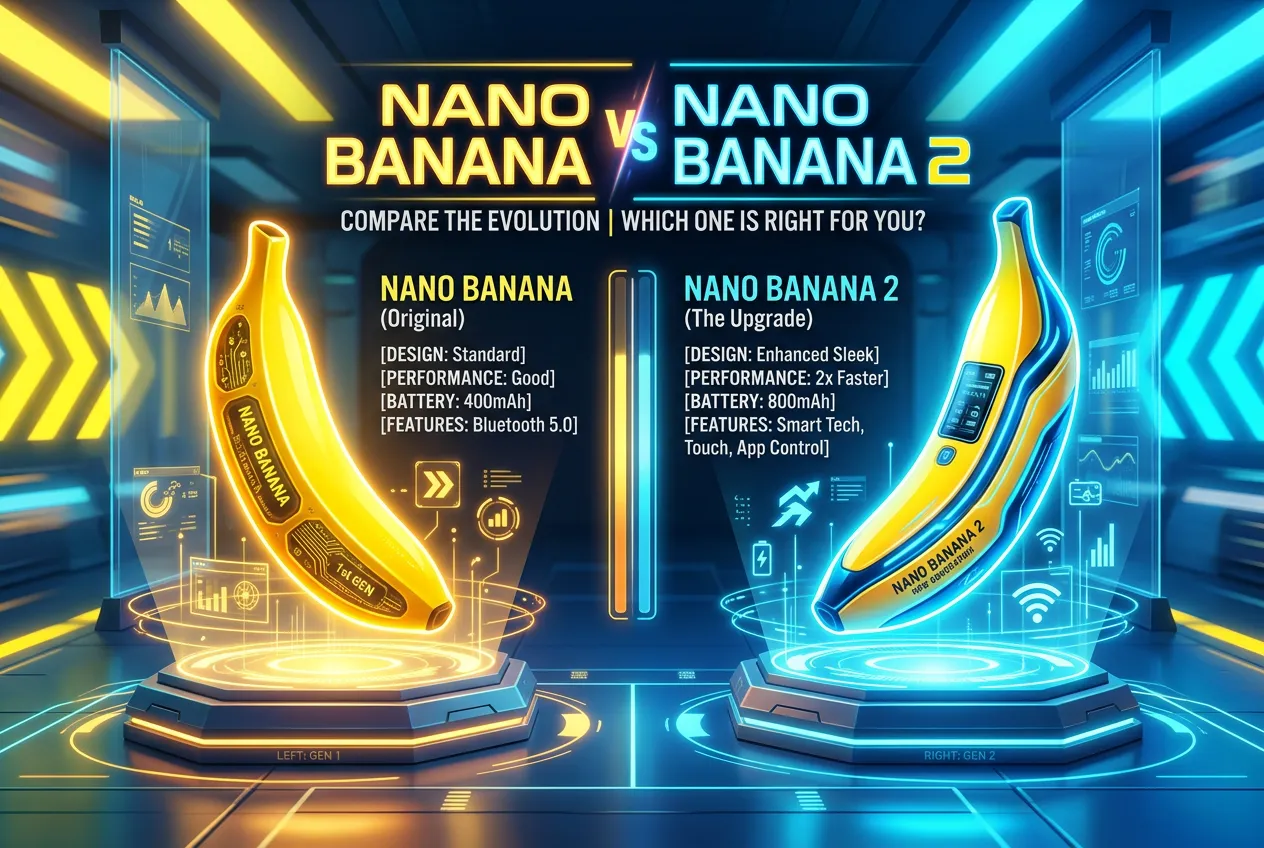
Nano Banana vs Nano Banana 2: 5 Prompts, Honest Results
Nano Banana vs Nano Banana 2 — Same 5 prompts on both. What changed, what stayed the same, and which one you should use now.
The Short Answer (If You're in a Hurry)
| Nano Banana | Nano Banana 2 | |
|---|---|---|
| Underlying model | Gemini 1.5 Flash Image | Gemini 3.1 Flash Image |
| Speed | Fast | Faster |
| Text rendering | Okay, often warped | Much better, stable across languages |
| Subject consistency | 3–4 characters | Up to 14 characters |
| Real-time knowledge | No | Yes (can use live data) |
| Best for | Quick drafts, fast iteration | Commercial work, complex scenes, precise control |
This isn't about which model is "better." It's about which one fits the task in front of you right now.
Why I Ran This Test
The question I kept seeing was simple: "I'm already using Nano Banana. Do I actually need to upgrade?" So I ran the same five prompts on both models without changing a word or swapping reference images. I judged on four things: how closely the output matched the prompt, whether any text in the image was readable and correct, how convincing the lighting and depth were, and whether the result was usable in a real project without further editing.
The 5 Prompt Tests: Side-by-Side Results
Test 1 — Product Visualization: Perfume Illustration to Photo
The Prompt:
Make this perfume illustration photorealistic. Frosted glass bottle, genuine marble cap with natural patterns. Studio lighting, luxury presentation.
On Nano Banana, the basic shape and materials showed up. Frosted glass sometimes read as flat, and the marble cap often got a repeating pattern instead of natural veining. Studio lighting was roughly correct but lacked a clear main and fill distinction — fine for a rough pass, not quite ready for client use.
On Nano Banana 2, frosted glass showed believable scatter and depth. The marble cap varied naturally run to run, no repeating tiles. Lighting had a clear main light and fill, so the bottle read as a real product shot. These came out usable for commercial or brand work without retouching.
Verdict: Nano Banana 2. The gap is biggest on material accuracy — especially when the prompt asks for something "genuine" or "natural."
Original · Nano Banana · Nano Banana 2 · Same prompt, same reference image
Test 2 — 3D Figure Scene Compositing
The Prompt:
Please turn this photo into a character figure. Behind it, place a box with the character's image printed on it. Next to it, add a computer with its screen showing the Blender modeling process. In front of the box, add a round plastic base for the figure and have it stand on it. The PVC material of the base should have a crystal-clear, translucent texture, and set the entire scene indoors.
Nano Banana struggled with the spatial layout. The base and box swapped depth or crowded each other in most runs. The PVC base came out frosted more often than clear. The computer screen showed a generic "software" look rather than anything that read as Blender. Usable as a rough concept mockup, not as a final asset.
Nano Banana 2 kept the spatial relationships more stable — figure, box, computer, and base each held their position across runs. The base showed plausible refraction for clear PVC. The screen produced a recognizable Blender-style interface. The whole scene was closer to something you'd put in a case study or product page.
Verdict: Nano Banana 2. Multi-element scenes with specific spatial relationships are where the gap between the two models is largest.
Original · Nano Banana · Nano Banana 2 · Same prompt, same reference image
Test 3 — AI Caricature Style
The Prompt:
A highly stylized 3D caricature of this Character, with expressive facial features, and playful exaggeration. Rendered in a smooth, polished style with clean materials and soft ambient lighting. Bold color background to emphasize the character's charm and presence.
Nano Banana got the caricature direction right. Exaggeration occasionally went too far and faces stopped feeling coherent. The "smooth, polished" material wasn't always consistent across the figure, and edges between the character and the bold background sometimes bled.
Nano Banana 2 kept the exaggeration within a more controlled range — still playful, less uncanny. Materials were more even across the figure, and the character separated more cleanly from the background. The result felt closer to a finished 3D render.
Verdict: Nano Banana 2 wins, but this is the smallest gap of the five tests. For personal or social use, Nano Banana is often enough here.
Original · Nano Banana · Nano Banana 2 · Same prompt, same reference image
Test 4 — Baby Face Generator (Multi-Reference Blending)
The Prompt:
With Nano Banana, one parent's features usually dominated. Skin tone transitions looked patchy between the two references, and the result felt more like a photo merge than a coherent face. The "professional photo quality" ask didn't always translate to convincing portrait lighting either.
Nano Banana 2 distributed features from both parents more evenly. Skin tone blended more naturally, and the overall face held together as a single person rather than a composite. Portrait lighting was more consistent with what "professional photo quality" actually implies. Multi-reference blending is one of the clearest Gemini 3.1 Flash Image improvements over its predecessor.
Verdict: Nano Banana 2. Blending two reference images is a meaningful upgrade from the older model.
Original · Nano Banana · Nano Banana 2 · Same prompt, same reference image
Test 5 — Conceptual Visualization: Engineer's Perspective
The Prompt:
Nano Banana gave an "engineering drawing" aesthetic. Labels and dimensions looked decorative rather than accurate, and the bridge's proportions drifted from the real structure. It read as stylistically inspired by technical drawings, not grounded in how the bridge actually looks.
Nano Banana 2 pulled from real-world geographic knowledge, so the Golden Gate Bridge's structure and proportions stayed closer to accurate. Annotations felt more like a real technical diagram rather than placeholder text placed for effect. The gap here isn't style — it's that one model is making things up and the other isn't.
Verdict: Nano Banana 2. Real-time knowledge turns conceptual visualization from a style exercise into something credible.
Nano Banana (left) vs Nano Banana 2 (right) · Same prompt, same reference image
What Nano Banana Still Does Well
Nano Banana, running on Gemini 1.5 Flash Image, is still fast on simple prompts. When you're not pushing for accurate text, many characters, or commercial-grade materials, it handles most things without friction. For high-volume ideation — mood boards, quick social posts, concept explorations where the brief is loose — the speed advantage is real. The upgrade question only becomes urgent when accuracy, consistency, or a client deliverable enters the picture.
When to Stick With Nano Banana
Stay on Nano Banana if most of your work is for yourself: personal projects, memes, social content, quick experiments. Same if you're validating a concept and don't need a final-quality asset. If API cost matters and your prompts are simple — single subject, no text in the image, no complex spatial layout — the older model handles it fine. There's no pressure to switch until your briefs get more demanding.
When to Move to Nano Banana 2
Switch to Nano Banana 2 when the output has to be correct and usable on first delivery: product shots, packaging, brand materials, or anything going directly to a client or audience. Use it when the image needs legible text — labels, callouts, multiple languages. Use it for scenes with more than a few distinct subjects, or when the image should reflect real, current information like geography or data. Gemini 3.1 Flash Image is built for that workload. For prompt ideas that hold up well on Nano Banana 2, the 15 prompts we tested here are a good starting point.
Which One Should You Pick
Nano Banana 2 came out ahead in all five tests, but the margin varied. The biggest differences were in multi-element spatial layout (Test 2) and real-world knowledge (Test 5). The smallest was in caricature style (Test 3), where Nano Banana was still acceptable for casual work. The decision is task-based: if a meaningful share of your output is client-facing or needs to be accurate, the newer model is worth it. If almost everything is personal or experimental, the original still holds up. Both models keep improving — this comparison will be updated as they do.
Author

More Posts
Why I Built Nano Banana Video
From image-to-video fragmentation to a single pipeline: why I built Nano Banana Video to connect Nano Banana image generation with AI video models in one workflow.
I Tested 100 Nano Banana 2 Prompts in 2026 — These 15 Actually Work
I tested 100+ Nano Banana 2 prompts. Here are the 15 that actually work — plus the mistakes most tutorials never tell you.